Getting Home
 Many fans of the B-17 claimed that the B-24 could not sustain as much damage and still fly. It is probably an argument that is pointless and will never be settled.
In many cases the aircraft were abandoned even though they could still fly. Often a plane that could stay in the air could not safely land. The pilot and crew needed to weigh the various risks.
No one wanted to be a prisoner of the Nazi army. Before bailing out it was strongly preferred to be over neutral or friendly land. Bailing out over or ditching in the North Sea left about a 10% chance of survival. Was it safe to attempt a landing? If so, should they find the nearest field or try for home?
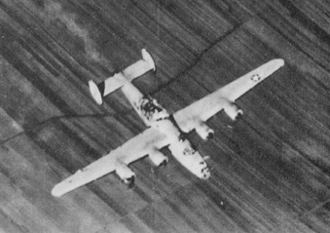
The B-24 shown above took a direct hit from an 88mm shell that exploded in the waist. The blast removed an estimated 12 feet of the upper fuselage. Control cables to the rear controls were severed. The remaining crew baled out. The incident occurred over Weiner Neustadt, Austria on 2 November, 1943.*
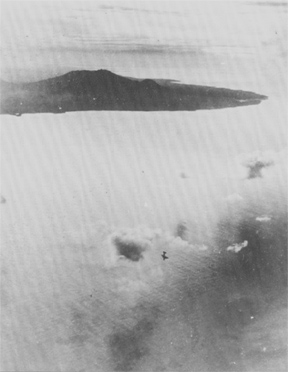
The aircraft shown at left has been abandoned and is diving toward the water. The crew will hope to be rescued from the cold water of the North Sea.
Certainly some B-24s returned to base with extreme damage. As much as the qualities of the aircraft, it depended on the skill of the pilot and co-pilot to fly these broken birds. The B-24 had heavy controls at best and required great physical strength at times. When crossed controls had to be maintained for long distances because of missing control surfaces or dead engines, the pilots were called upon to go beyond themselves. It could require all the strength of two men at the controls to maintain straight and level flight.
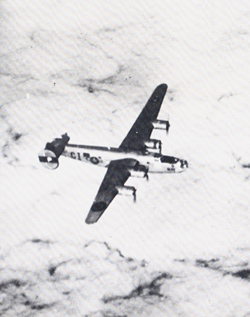
That was the case with the 392nd BG B-24H shown below. It was flown back to England after the left stabiliser was blown off. The crew managed to parachute to safety as a landing was not possible.
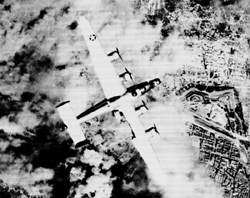 This B-24 (picture at left) continued to fly after the right flap was completely torn away.
NEXT PAGE